

Table of Contents
- Texas Commercial Property Flood Insurance Cost 2026: Key Drivers
- Risk Rating 2.0 and Actuarial Pricing
- Commercial-Specific Underwriting Variables
- Factors Affecting Commercial Flood Insurance Premiums
- Private vs NFIP Flood Insurance for Business: Which Fits Your Risk?
- How to Reduce Commercial Flood Insurance Costs
- 2026 Regulatory Changes and Multi-Location Portfolio Strategies
- Why Standard Commercial Property Policies Exclude Flooding
- Frequently Asked Questions
Last Updated: September 14, 2026
Texas Commercial Property Flood Insurance Cost 2026: Key Drivers
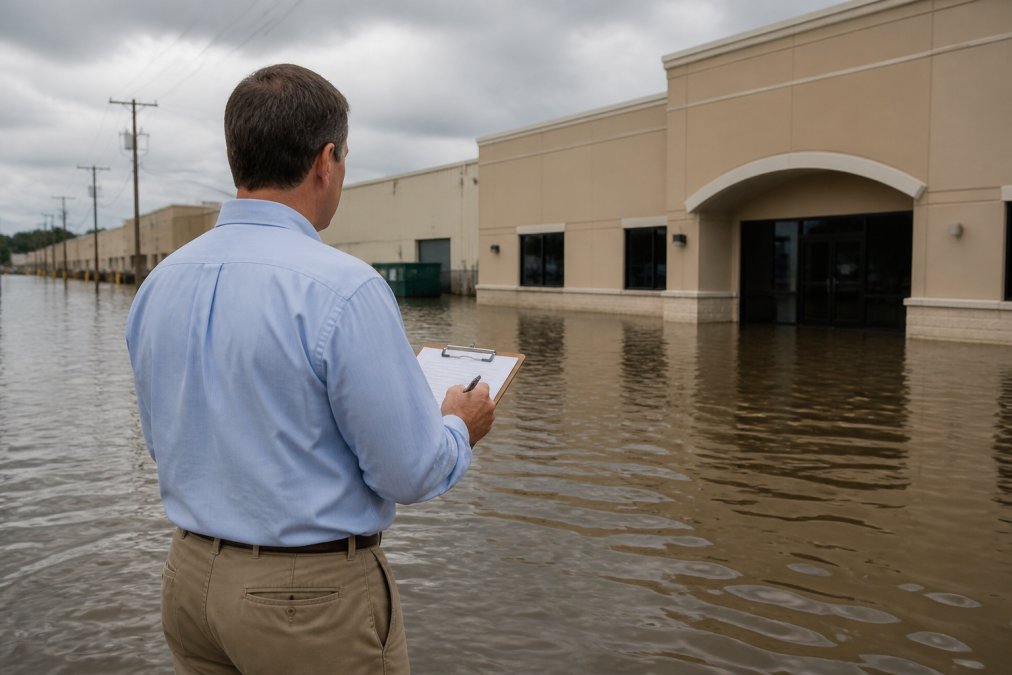
Flooding is one of the most underestimated risks for Texas business owners, and the Texas commercial property flood insurance cost 2026 landscape looks nothing like it did five years ago. Carriers have moved from broad flood zone tables to property-level pricing, rewarding owners who understand what drives their rate and punishing those who assume their commercial property policy has them covered.
Pricing is now tied to the specific building, not the neighborhood: two warehouses on the same street can carry dramatically different premiums because of elevation, construction type, and occupancy.
Below: what moves your premium, how the NFIP compares to private carriers, and how to cut cost without gutting coverage.
Risk Rating 2.0 and Actuarial Pricing
The National Flood Insurance Program now prices policies using Risk Rating 2.0, which replaced flood-zone tables with property-specific actuarial risk (fema.gov). Instead of the zone designation driving the rate, the NFIP evaluates distance to water, elevation relative to Base Flood Elevation (BFE), replacement cost value (RCV), and rebuild cost for that structure.
For commercial owners, the physical reality of your building matters more than the map: a property in a Special Flood Hazard Area (SFHA) sitting well above BFE can price better than a lower-elevation building outside the mapped zone.
Commercial-Specific Underwriting Variables
Commercial flood underwriting weighs variables residential policies never touch: business interruption exposure, specialized equipment value, inventory concentration, and tenant count. A restaurant with walk-in refrigeration and a data center with raised flooring carry very different exposure profiles at the same elevation.
Carriers also weigh:
- Occupancy type and how quickly a business could resume operations after a flood
- Building age, construction materials, and foundation type
- Basement or ground-level storage of high-value inventory
- Whether the property sits in a coastal high-hazard area
Factors Affecting Commercial Flood Insurance Premiums
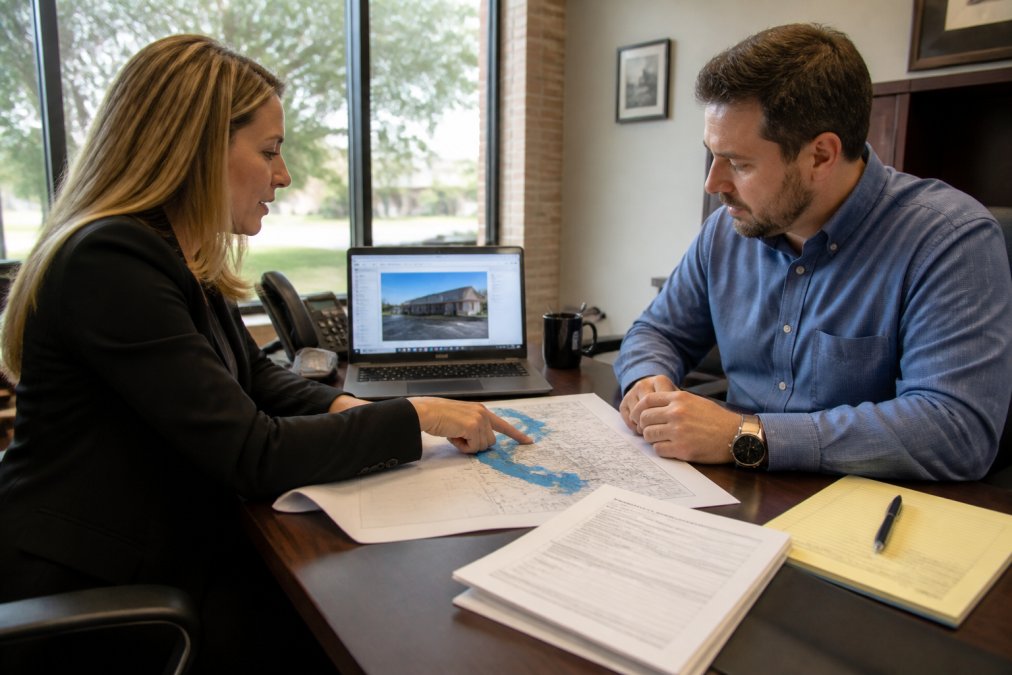
The most influential variables are elevation relative to BFE, replacement cost value, deductible structure, and coverage limit. An elevation certificate documenting your building’s lowest floor elevation can materially change your premium by letting underwriters price accurately rather than conservatively.
Other factors: distance to water, first-floor height, and mitigation like barriers, sump systems, or elevated utilities.
If you don’t have a current elevation certificate, get one. Many commercial owners overpay simply because the carrier assumes the worst about their building’s elevation. An accurate certificate often pays for itself in the first policy term.
Deductible structure deserves attention. A higher deductible lowers your premium, but with significant inventory or equipment value, the wrong one can leave you absorbing a loss you can’t afford. Match the deductible to your cash reserves, not just the premium line.
Private vs NFIP Flood Insurance for Business: Which Fits Your Risk?
The decision is more mechanical than most guides admit. The NFIP is a federal program with statutory caps and one rating methodology; the private market is a collection of carriers, MGAs, and surplus lines markets that each underwrite differently. Knowing where each breaks down determines whether you need one, the other, or both.
What the NFIP Actually Offers a Commercial Property
The NFIP writes commercial coverage through its Standard Flood Insurance Policy (SFIP), a separate form from the residential Dwelling Form. Two structural limits matter most:
- Building coverage is capped per structure, and contents coverage is capped separately. For a commercial building with substantial replacement cost value, those caps are frequently well below what it would take to rebuild and restock.
- Business interruption is not covered under the NFIP SFIP (Buy a Flood Insurance Policy). Lost income, extra expense, and continuing lease obligations during a flood-related closure are not part of the standard form. That single gap is often the deciding factor for restaurants, retail, and any operation with thin margins.
- Basement and below-grade contents are subject to specific limitations, which matters for owners with mechanical equipment, storage, or utilities below the lowest floor.
A common pattern: an owner buys the maximum NFIP limit, then discovers after a loss that the building cap, contents cap, and lack of BI coverage leave a seven-figure hole. The NFIP is a floor, not a ceiling, for most commercial risks.
Where Private Carriers Pull Ahead
Private flood insurance for commercial property has expanded because carriers built their own flood models and can price risk more granularly than the NFIP allows. For a well-documented building, private markets frequently offer:
- Limits set to full replacement cost value, not a statutory cap
- Business interruption and extra expense built into the form or available by endorsement
- Broader contents coverage, including some below-grade property
- Portfolio-level underwriting for owners with multiple locations
- Difference-in-conditions (DIC) and excess placements that sit above an NFIP primary layer
A common structure: keep an NFIP policy as the primary layer (which also satisfies most lender flood requirements in a Special Flood Hazard Area), then place a private excess or DIC policy above it to close the coverage gap. That layered approach is one of the most underused strategies in commercial flood placement.
Side-by-Side Comparison
| Feature | NFIP (SFIP) | Private Flood Insurance |
|---|---|---|
| Coverage limits | Statutory caps per building and contents | Can be set to full RCV |
| Business interruption | Not included in the standard form | Often included or available by endorsement |
| Pricing basis | Federal actuarial rating methodology | Carrier-specific underwriting and models |
| Below-grade contents | Limited | Varies; some carriers offer broader terms |
| Excess / DIC layering | Available separately | Frequently built into program structures |
| Portfolio underwriting | Not available | Common with select carriers |
| Best for | Lower-value properties, lender-required primary layer | High-value, complex, or multi-location commercial assets |
How to Decide
A practical decision framework:
- If a lender requires flood coverage because the property sits in a Special Flood Hazard Area, an NFIP policy is often the simplest way to satisfy that requirement.
- If your building RCV or contents value exceeds the NFIP caps, you need a private layer regardless of what the NFIP provides.
- If a flood closure would meaningfully interrupt revenue, business interruption coverage is the deciding factor, and that points to the private market or a DIC placement.
- If you own multiple locations, ask a broker to quote the portfolio to private carriers before defaulting to individual NFIP policies.
NFIP Summary of Coverage for commercial property
For most commercial properties with meaningful RCV or revenue exposure, the answer is not “NFIP or private”, it is NFIP as the primary layer plus a private excess or DIC policy above it. That structure satisfies lenders and closes the coverage gaps the federal form leaves open.
Coverage Limits and Exclusions to Compare
Commercial property policies almost universally exclude flooding, which is why a separate flood policy exists. When comparing NFIP and private options, check exclusions: basement contents, outdoor property, vehicles, and certain foundation elements are common gaps. Business interruption is where private policies often pull ahead, since flood closures can stall revenue for months. Read the actual form, not the marketing summary, before you bind.
How to Reduce Commercial Flood Insurance Costs
Reducing your premium starts with better information and lower actual risk. Practical steps:
- Obtain a current elevation certificate to document true elevation
- Install flood mitigation measures such as barriers, backflow valves, and elevated mechanical systems
- Raise your deductible to a level your reserves can absorb
- Bundle flood coverage with your commercial property policy where a carrier allows it
- Shop the private market against the NFIP rather than assuming one is cheaper
- Review coverage limits annually as your RCV changes
A common mistake is treating flood insurance as set-and-forget. Property values, inventory levels, and building improvements change, and stale coverage either overprices you or leaves gaps.
Dropping flood coverage to cut costs is the most expensive mistake a commercial owner can make. A single flood event can exceed the entire premium savings of a decade, and lenders often require coverage as a condition of financing.
2026 Regulatory Changes and Multi-Location Portfolio Strategies
Two forces are reshaping commercial flood pricing in 2026: the refinement of the NFIP’s Risk Rating 2.0 methodology and the private market’s growing appetite for well-documented commercial portfolios. Owners who understand both can place coverage individual-property buyers cannot access.
What Is Actually Changing Under Risk Rating 2.0 for Commercial Risks
Risk Rating 2.0 replaced flood-zone rating tables with property-level actuarial pricing. For commercial owners:
- Distance to water and elevation relative to Base Flood Elevation (BFE) now carry more weight than the mapped flood zone. A building in a Special Flood Hazard Area that sits well above BFE can price better than a lower building outside the mapped zone.
- Replacement cost value (RCV) is a direct rating input. As construction costs have risen, RCV-driven premium increases have followed, which means an outdated RCV on your policy is not just a coverage problem, it is a pricing problem.
- Building characteristics, foundation type, first-floor height, construction materials, and the presence of below-grade space, feed the rating in ways the old zone tables never captured.
- Full-risk rates phase in over time for policies that were previously subsidized, which is why some commercial owners have seen multi-year step-ups rather than a single reset.
The takeaway for 2026: the levers that move your premium are physical and documentary, not geographic. Elevation certificates, accurate RCV, and mitigation features are now the primary cost controls.
Private Market Capacity in 2026
Private flood carriers have expanded commercial appetite, especially for well-documented risks outside the most extreme coastal hazard zones. Two trends matter:
- Surplus lines markets are writing larger commercial flood limits than the admitted market, which matters for high-RCV industrial and hospitality risks.
- Parametric and structured flood products are appearing in the commercial space, though they pay on a trigger rather than on actual loss, so they are a supplement, not a replacement, for an indemnity flood policy.
A broker who only quotes the NFIP is leaving capacity on the table. The private market should be quoted on every commercial flood placement in 2026.
Multi-Location Portfolio Strategies
Insuring commercial properties one building at a time is the most expensive way to buy flood coverage. A portfolio approach changes the economics three ways:
- Consolidated risk assessment. Present all locations to a single carrier with consistent elevation documentation, RCV schedules, and occupancy data. Carriers price portfolios more efficiently than they price isolated buildings because the correlation of losses across a diversified geographic footprint is lower than the correlation within a single concentrated area.
- Layered limits across the portfolio. Instead of buying maximum limits on every building, allocate higher limits to the locations with the greatest revenue exposure and use a shared or blanket limit structure where the carrier allows it. This reduces total premium while keeping the catastrophic exposures covered.
- Consistent documentation across all sites. Elevation certificates, updated RCV schedules, and mitigation documentation should be uniform across the portfolio. A single site with stale documentation can drag the whole placement’s pricing.
A common pattern: one or two poorly documented properties force the carrier to price conservatively across the entire submission. Fixing those sites often unlocks better terms for the whole portfolio.
Before your next renewal, build a one-page schedule of every location with its elevation certificate date, current RCV, occupancy type, and any mitigation features. Brokers who receive that schedule up front can quote the portfolio to private carriers that would otherwise decline to look at it.
What to Do Before Your 2026 Renewal
- Confirm every property has a current elevation certificate on file
- Update RCV on every schedule to reflect current construction costs
- Ask your broker to quote the NFIP and at least two private markets, including a portfolio submission
- Review whether a DIC or excess layer is needed above the NFIP primary
- Document mitigation features (barriers, backflow valves, elevated utilities) in writing for the underwriter
Owners who treat each property in isolation pay more and still carry gaps between policies. The 2026 market rewards a documented, consolidated risk, a broker conversation, not a self-service purchase.
Why Standard Commercial Property Policies Exclude Flooding
Flood is excluded from standard commercial property policies because the risk is catastrophic and correlated: one event can damage thousands of properties at once, making it uninsurable under ordinary property underwriting. That’s why flood coverage is written separately, through the NFIP or a private carrier.
Understanding this exclusion is the foundation of any commercial asset protection plan. If you assume your commercial property policy covers flooding, you may discover the gap only after a loss. Review your exclusions directly, or have a broker walk through them.
Flood risk doesn’t wait for a convenient moment, and the pricing landscape for commercial coverage continues to shift. Glenn Davis Insurance has served Texas businesses since 1974 as a fully independent agency, which means we compare carriers rather than push a single company’s product. Our team can review your property exposure, help you gather the documentation underwriters need, and match you with coverage that protects your assets at a competitive price. Get started with Glenn Davis Insurance and secure a commercial flood policy built around your actual risk.
Frequently Asked Questions
How much is commercial flood insurance for a business in Texas?
There is no single rate. Commercial flood insurance cost depends on your building’s flood zone, elevation, replacement cost value, deductible, and whether you choose NFIP or private coverage. NFIP commercial policies have statutory maximums, while private insurers set their own limits and pricing. For a property-specific estimate, request a quote from an independent agency that can compare multiple carriers.
What factors affect commercial flood insurance premiums?
Key rating factors include flood zone designation, base flood elevation (BFE), building age and construction, occupancy type, claims history, and the amount of coverage you buy. Under Risk Rating 2.0, FEMA also considers distance to water and replacement cost. Private insurers may weigh business interruption exposure and risk mitigation features like flood vents or barriers.
Is flood insurance mandatory for commercial properties in high-risk zones?
If your commercial property is in a Special Flood Hazard Area (SFHA) and you have a federally backed mortgage, flood insurance is required. Even without a mortgage, many landlords and business owners carry it to protect their assets. Note that standard commercial property policies exclude flood, so a separate policy is needed.
How can I reduce my commercial flood insurance costs?
You can lower premiums by obtaining an elevation certificate to confirm your building’s true risk, choosing a higher deductible, and implementing flood mitigation measures such as barriers or sump pumps. For multi-location portfolios, a single carrier may offer package discounts. An independent broker can compare private and NFIP options to find the most competitive rate for your risk profile.